






Treating rust on a classic car with FEROSE
On a classic car, rust settles wherever water lingers: floor pan, sills, windscreen aperture, boot floor, wheel arches. Stripping it back to bare metal takes time, and bare metal rusts again very quickly if it is not protected straight away.
The principle: convert the rust rather than remove it
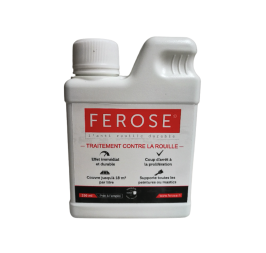
FEROSE is a rust converter. It chemically neutralises existing rust and isolates the metal from air and moisture. The treated surface then acts as a base for paint, filler or resin, and you can even weld on it without stripping. It contains neither phosphoric nor hydrochloric acid.
The steps
- Prepare: brush off loose flakes and dust. There is no need to sand down to bare metal.
- Apply: apply a first coat by brush or roller, working the product well into the rust.
- Let it work: the reaction is visible in about 10 minutes at 20 °C. A second coat can be applied after 2 hours.
- Finish: after 12 hours, cover with your paint, filler or resin, or weld directly.
How much do you need?
One litre treats about 15 m² as a first coat. The 250 ml bottle is enough for touch-ups; the litre covers a floor pan or sills; the 5 and 10 L cans suit full restorations, with the lowest price per litre.
Good to know
- FEROSE withstands up to 250 °C: it is suitable for the exhaust line, but not for the manifold, turbo or particulate filter.
- It must not be used on items in contact with food.
FEROSE is available from 250 ml to 10 L on the Tido-distribution FEROSE page, shipped within 48/72 h, or collected free of charge at our shows if ordered 3 days in advance.
Related product
Related posts
 Welcome to Tido-distribution
Discover our new free sample service!
Looking back on our first show in Bologna 🇮🇹
Meet Tido-distribution at Epoqu’Auto 2026 – Hall 5, stand W1
Thank you for Epoqu’Auto 2026!
Leave a comment